Whether you’re thinking of cutting back on alcohol or simply curious about the phenomenon, Dry January has a richer history than most people realize. Here are 10 genuinely interesting facts about Dry January, verified by our editorial team.
The concept of Dry January goes back as far as 1942.

While Alcohol Change UK officially launched Dry January as a modern public health campaign in 2013, the idea of abstaining from alcohol throughout January stretches back to wartime Finland. During the Continuation War in the early 1940s, the Finnish government launched a “Sober January” initiative urging citizens — especially those serving in the military — to stop drinking in order to conserve national resources. The campaign was promoted through magazines and newspapers and was widely considered a success, making Finland the unlikely originator of a tradition that would eventually spread across the globe.
Millions of people practice Dry January every year.

When Alcohol Change UK launched the modern Dry January campaign in 2013, a modest 4,000 people signed up — but growth since then has been remarkable. By 2023, more than 175,000 people in the UK had officially registered to participate, and in the United States, surveys suggested that around 15% of the adult population — roughly 39 million people — were attempting to go alcohol-free for the month. The movement has clearly struck a nerve, particularly as awareness of alcohol’s health impacts has grown alongside rising consumption rates since the 1990s.
Dry January® USA was officially launched in 2024.

The American chapter of Dry January came into formal existence in 2024, when Alcohol Change UK entered into a five-year exclusive licensing agreement with Meharry Medical College in Nashville, Tennessee — one of the oldest and most respected historically Black medical institutions in the United States. The partnership formalized the rollout of the campaign across America, with Meharry’s focus on health equity and wellness aligning closely with Dry January’s mission. The campaign has also been established in Norway, Iceland, Germany, and Switzerland, reflecting Alcohol Change UK’s push to grow the initiative internationally.
Dry January was inspired by a woman who wanted to get fit for a run.

The origin of the modern Dry January campaign traces back to a personal decision made by Emily Robinson, who in early 2011 signed up to run a half marathon in February and decided to give up alcohol in January to make her training more effective. She slept better, felt more energetic, and lost weight — and the positive changes she experienced sparked so much interest from friends and colleagues that she began sharing her story more widely. When Emily joined Alcohol Change UK the following year, the charity recognized the power of her experience and built the first official Dry January campaign around it, launching in January 2013.
The UK Government promotes Dry January.
From 2014 onward, Public Health England — the UK Government’s health agency at the time — began formally endorsing the Dry January campaign, lending it significant institutional credibility. The government chose to launch its support on Friday, December 19, 2014, a date that had earned the tongue-in-cheek nickname “Black Friday of booze” due to the spike in alcohol sales that typically occurs just before Christmas. Framing the campaign as an opportunity to give the body a post-festive reset, the initiative positioned January as the ideal moment to save money, shed holiday weight, and start the new year feeling healthier.
Dry January peaked in 2022.

Participation in Dry January reached an all-time high in 2022, with approximately 19% of the American population taking part — a surge that followed a significant spike in alcohol consumption during the COVID-19 pandemic of 2020 and 2021. Global alcohol sales increased by around 3% in 2020 alone, the largest single-year jump in over half a century, with surveys indicating that roughly a quarter of people were drinking more than they had before the pandemic. Historians note this is not unprecedented: alcohol consumption also rose notably following the 1993 World Trade Center bombing and the September 11 attacks, suggesting that societal stress consistently drives people toward increased drinking.
88% of Dry January participants save money.
A 2019 study from the University of Sussex tracked participants through and beyond Dry January, finding a range of significant and lasting benefits. 88% of participants saved money, 70% reported better overall health, 71% slept better, and 67% had noticeably higher energy levels. Perhaps most strikingly, 93% of participants felt a genuine sense of personal achievement after completing the month — and more than half reported improvements in their skin quality and ability to concentrate. The research also found that participants continued to drink less than before in the months that followed, suggesting Dry January can create meaningful, long-term behavior change.
Dry January has inspired Dry February and Sober October.
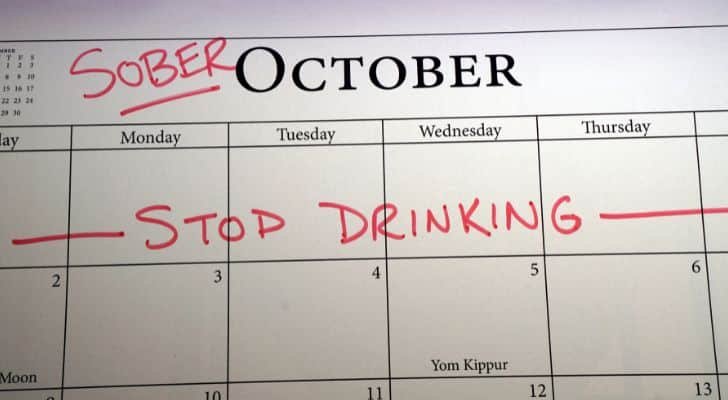
Dry January’s success has sparked similar campaigns in other months throughout the year. Sober October, which runs alongside Macmillan Cancer Support’s fundraising efforts in the UK, invites participants to go alcohol-free in the autumn as an alternative reset point. In Canada, the Canadian Cancer Society champions Dry February, which doubles as a fundraiser for cancer research while helping participants experience the health benefits of an alcohol-free month — with the added psychological bonus that February is the shortest month of the year, making the challenge feel slightly more approachable for newcomers.
Lots of celebrities take part in Dry January.

High-profile names including Bella Hadid, Mila Kunis, and Ashton Kutcher have publicly participated in Dry January, helping to normalize the practice and bring it into mainstream conversation. For some celebrities, the experiment has become a permanent lifestyle shift: actress Rumer Willis has spoken openly about how participating in Dry January led her to give up alcohol altogether, describing the experience as a realization that she didn’t need alcohol to feel confident or interesting. When the campaign launched in 2013, it received early backing from Alistair Campbell, the influential former political aide who has spoken candidly about his own history with alcohol dependency, describing Britain’s drinking culture as one of the most challenging environments in the world for sobriety.
Dry January is more popular with women than men.
Survey data consistently shows that women are more likely than men to participate in Dry January. In the UK, a 2021 survey found that 14% of women planned to participate compared with 11% of men, with the gap narrowing slightly the following year. In the United States, the difference is more pronounced — 57% of women said they were likely to take part, compared with 42% of men. This pattern may partly reflect the fact that alcohol affects women’s physiology more severely: women metabolize alcohol more slowly, absorb a greater proportion of it relative to body weight, and face a heightened risk of alcohol-related conditions including breast cancer, liver disease, and cognitive decline.
The evidence is clear: taking a month off from alcohol can deliver real and lasting benefits to your health, wallet, and well-being. Whether you’re motivated by a fitness goal, a desire to sleep better, or simply curiosity about how you feel without it, Dry January offers a low-pressure way to find out. Millions of people around the world have already discovered what a difference one alcohol-free month can make.
Great facts are worth sharing — and we’d say these 10 interesting facts about Dry January definitely qualify. At Kaleeg, we’re passionate about making learning enjoyable for everyone. If this list hit the mark, explore our other fact collections and keep the curiosity alive!




 ↑
↑