Curious minds, this one’s for you. We’ve put together several genuinely fascinating facts about The American Tradition of Hiding the Christmas Pickle, carefully reviewed by our team to ensure every single one is accurate and worth your time. Let’s dive in.
Origin of the Christmas pickle tradition.

There are quite a few origin stories about how hiding the pickle became an American Christmas tradition.
One of the most popular claims is that it was originally a German tradition.
According to the legend, a German-American soldier captured during the U.S. Civil War asked for a pickle on Christmas Eve, and after eating it, had enough strength to survive.
After returning to Germany, he is said to have started a tradition of hiding a glass pickle at Christmas to honor this life-saving snack.
There’s one major problem with this theory, however: it’s almost completely unknown in Germany. In one survey, over 90% of Germans hadn’t even heard of the Christmas pickle.
Even the pickle’s name in this story, Weihnachtsgurke (German for “Christmas pickle”), wasn’t an actual German word until Americans kept asking about it.
Another origin story linked to the tradition has a much darker tone.
Here, in the 19th century, two Spanish boys returning from school were captured by an evil innkeeper and locked in a barrel full of pickles.
Luckily, St. Nicholas (a.k.a the inspiration for Santa Claus) rescued them before it was too late, and that’s how the tradition of searching for the pickle on Christmas morning supposedly began.
The final theory, and arguably the most believable, suggests the tradition began as a marketing strategy.
Back in the 1840s, fruit-shaped glass Christmas tree ornaments were pretty popular in Europe. By the 1880s, Woolworth’s had become a major importer of these ornaments from Germany.
Some believe that some salesmen probably had lots of unsold pickle-shaped Christmas tree ornaments and came up with the storyline to drive sales.
Since then, the tradition of hiding the Christmas pickle has spread throughout the country.
The meaning behind the Christmas pickle tradition.

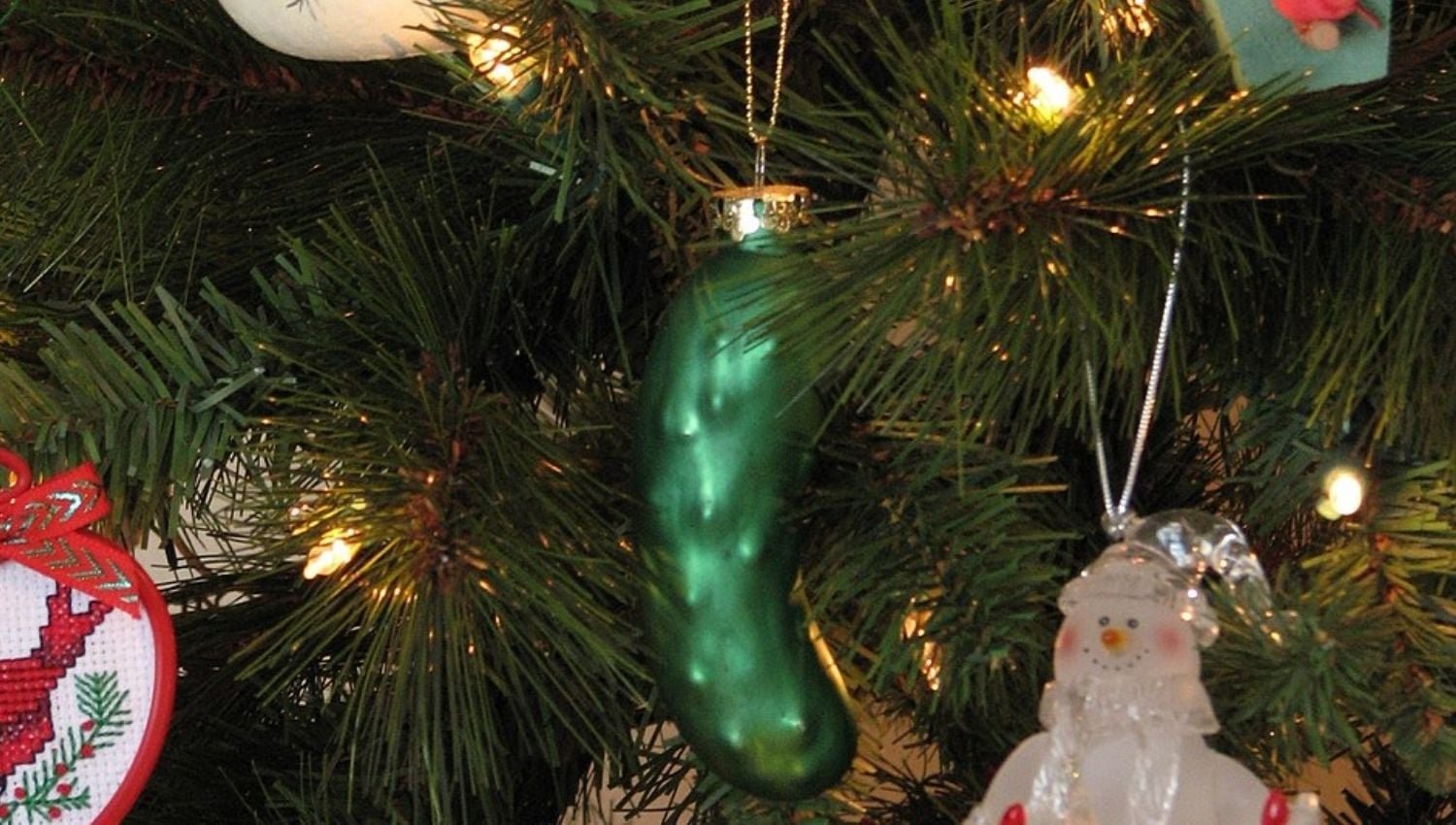
The Christmas pickle is believed to symbolize good fortune. So, whoever finds the Christmas pickle first on Christmas morning gets good luck for the rest of the year.
In many families, the winner of the Christmas pickle hunt also gets a special present or is given the honor of being the first to open their Christmas presents.
Nevertheless, winning the prize isn’t the most important part of this tradition. At its core, hiding the Christmas pickle is all about bringing the family together.
An easy way to set up the Christmas pickle game.
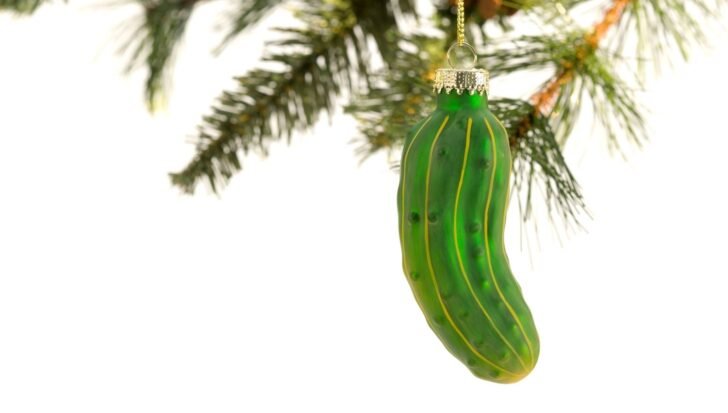
Starting the Christmas pickle tradition in your family is simple. The first step is getting your Christmas pickle ornament.
A glass ornament is traditional, but many modern forms are available, and even homemade papier-mache or crochet designs are great.
If you want to make the contest a little more competitive, select a gift for the winner, wrap it, and place it beneath the Christmas tree in advance.
On Christmas Eve, hide the Christmas pickle deep within the branches of the Christmas tree. Make sure it’s well hidden and won’t be spotted at first glance.
When you wake up on Christmas Day, get the family together and begin the hunt for the Christmas pickle. Whoever finds the pickle first wins the game and gets to claim the present.
Christmas traditions that actually came from Germany.

While hiding the pickle isn’t generally considered a true German Christmas custom, many other Christmas traditions popular in the U.S. today have genuine German origins.
One of the most common is the Christmas tree itself. As early as the 1550s, Germans were already setting up Christmas trees in their homes, and they carried that tradition to America when they migrated.
Advent calendars are another German tradition that has become popular globally, and it all started with a German mom making little boxes of sweets as a simple countdown to Christmas for her son.
Gingerbread houses also trace their origins to Germany in the 1800s and were inspired by the story of Hansel and Gretel.
Lastly, nutcrackers have German origins, too, dating back to traditional folk art and Christmas markets in the 19th century.
Contrary to popular belief, there’s really not much evidence that hiding the Christmas pickle is a true German tradition.
Nonetheless, it has now become an integral part of the Christmas celebration not only in the Midwest but throughout the United States.
This simple tradition brings additional cheer on Christmas mornings and helps the family bond over a lighthearted competition.
Kaleeg Editorial Note: We hope these several facts about The American Tradition of Hiding the Christmas Pickle sparked your curiosity! Our team works hard to bring you accurate, engaging fact lists across every topic imaginable. If you loved this article, explore more in our fact library — and don’t hesitate to get in touch if you’d like to suggest a topic!



 ↑
↑